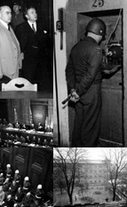
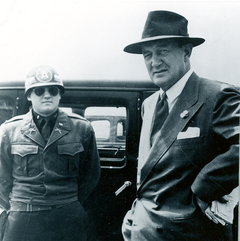
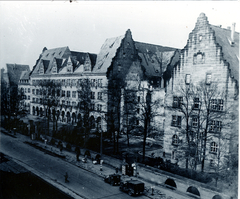
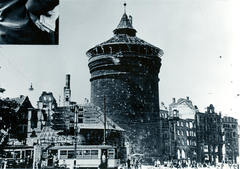
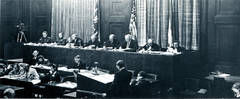
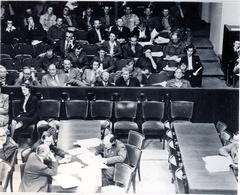
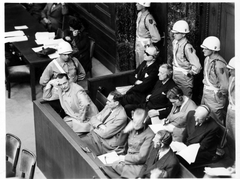
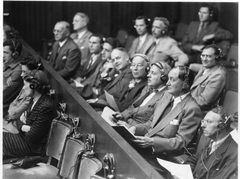
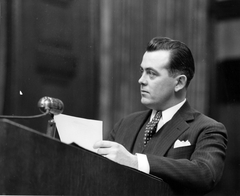
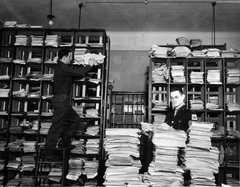
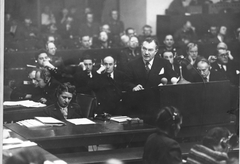
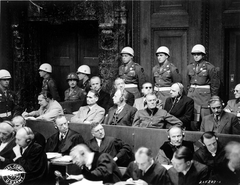
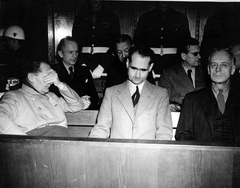
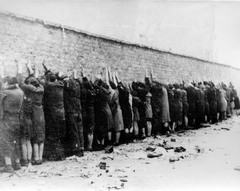
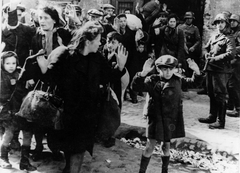
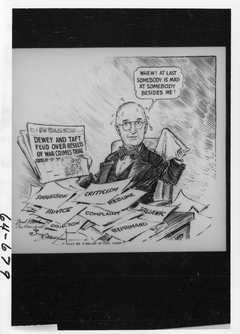
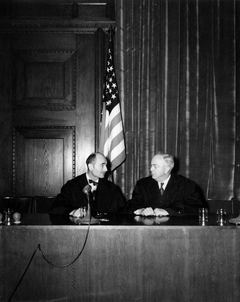
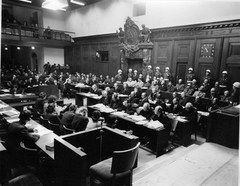
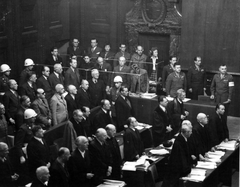
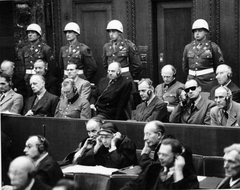
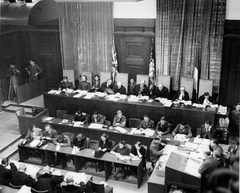
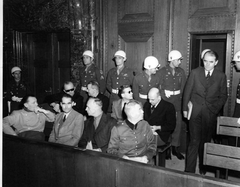
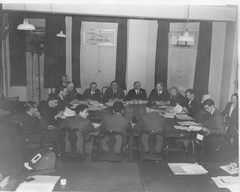
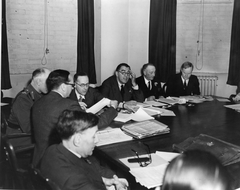
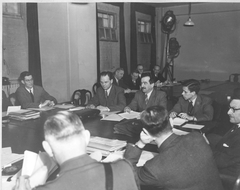
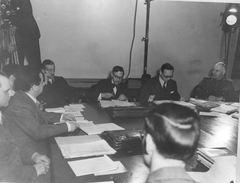
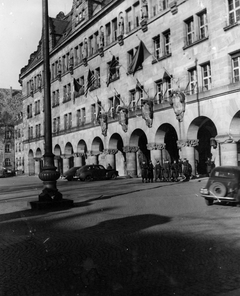
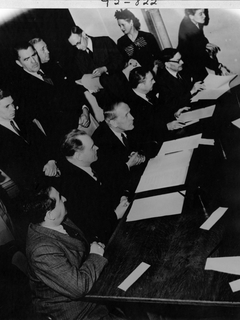
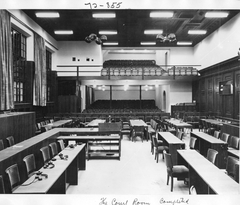
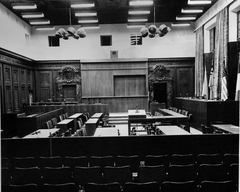
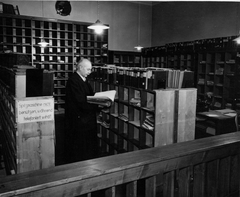
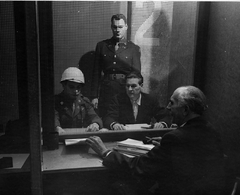
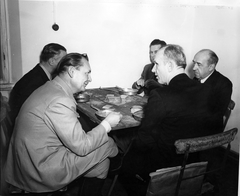
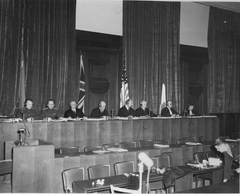
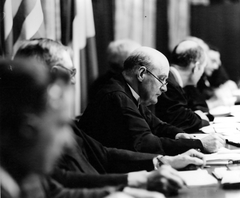
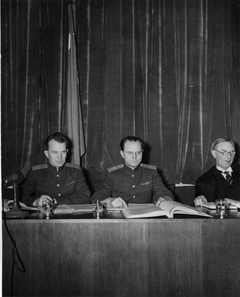
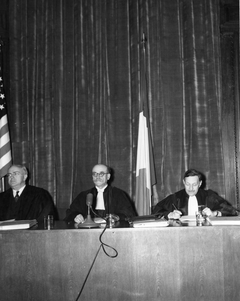
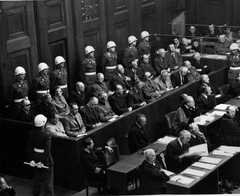
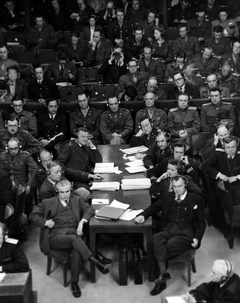
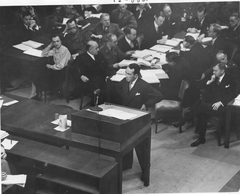
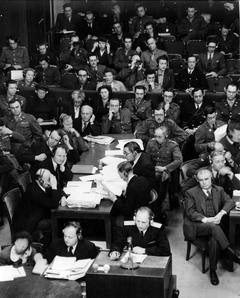
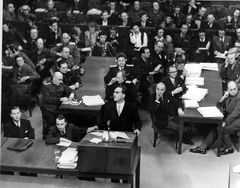
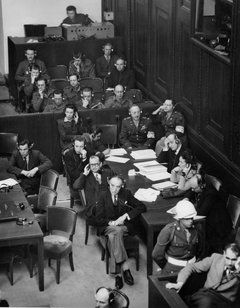
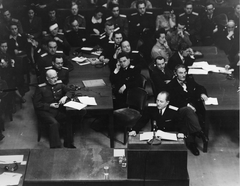
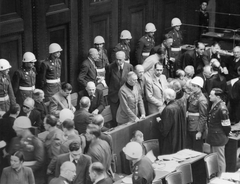
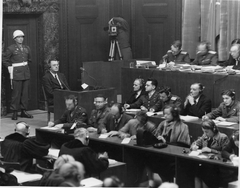
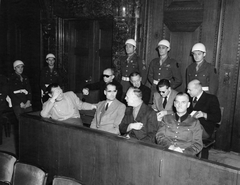
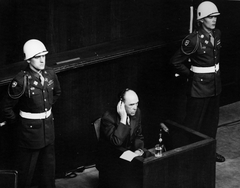
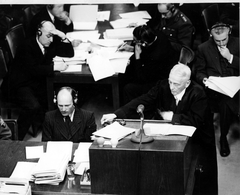
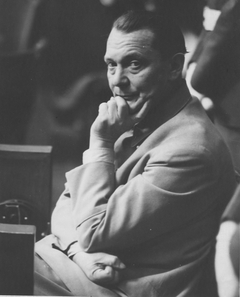
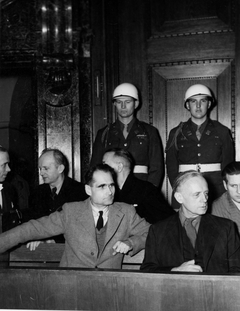
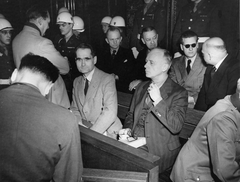
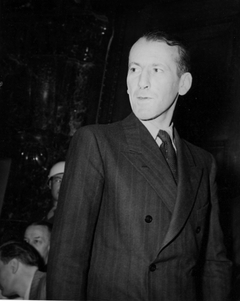
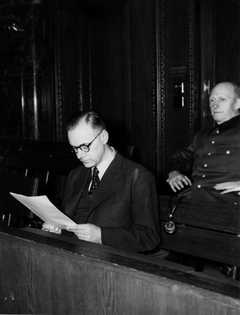
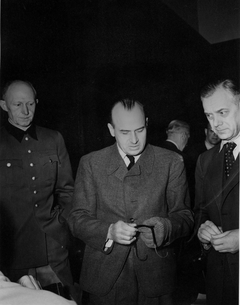
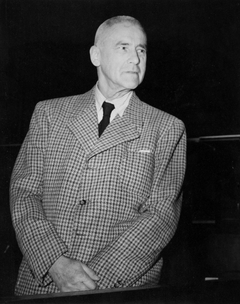
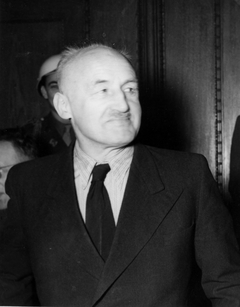
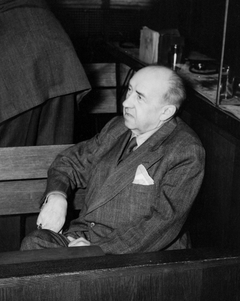
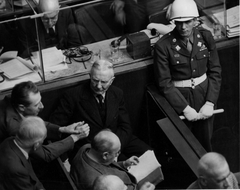
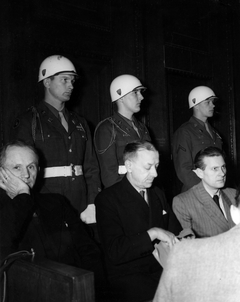
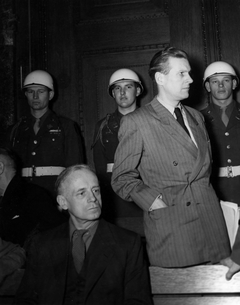
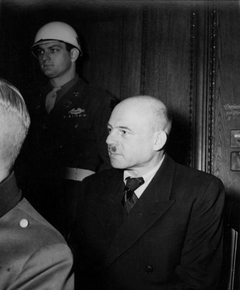
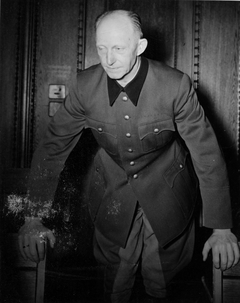
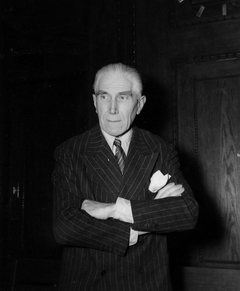
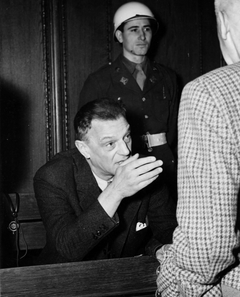
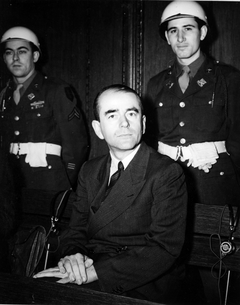
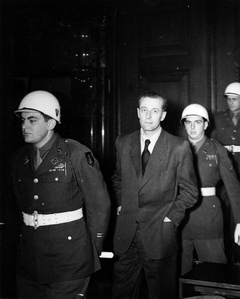
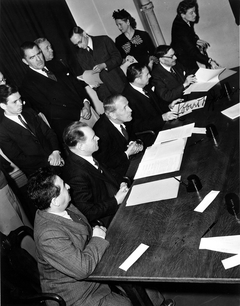
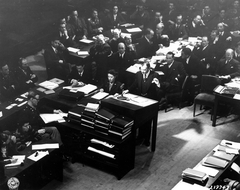
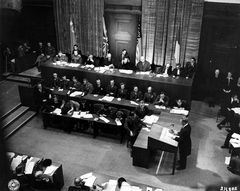
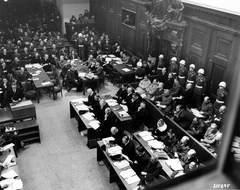
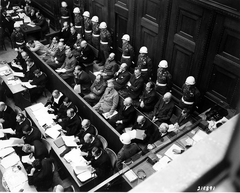
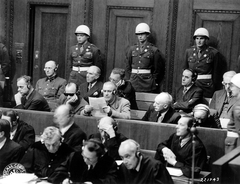
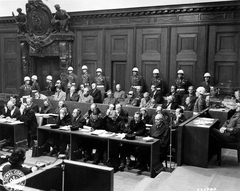
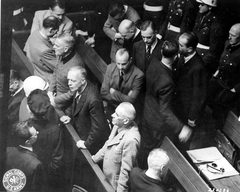
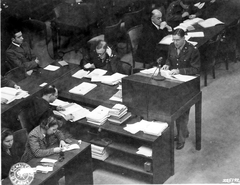
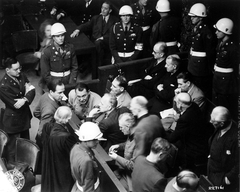
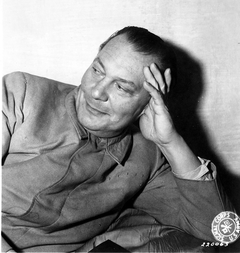
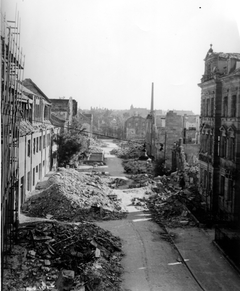
These pages are the result of a collaborative partnership among the Harry S. Truman Library & Museum, the Arthur W. Diamond Law Library at Columbia University Law School and the Jacob Rader Marcus Center of the American Jewish Archives at Hebrew Union College. The collection contains selected documents from the Nuremberg War Crimes holdings of these three institutions.
This collection includes 162 documents totaling 2000 pages covering the years 1943 through 1952. Supporting materials include photographs, oral history transcripts, additional finding aids and a chronology of events spanning the years from 1941 through 1948.
August 14: President Franklin Roosevelt and Prime Minister Winston Churchill announce their signing of the Atlantic Charter, making known their common principles in national policies on which they base their hopes for a better future for the world.
1942
January 1: The United Nations Declaration vows to continue hostilities against the Axis powers until such powers lay down their arms on the basis of unconditional surrender. Twenty-six nations sign the declaration in Washington D.C., affirming the principles of the Atlantic Charter. They pledge full employment of their military and economic resources against the Axis powers, and promise not to make a separate armistice and peace with their common enemies.
August 12-16: At the First Moscow Conference Premier Josef Stalin, U.S. Ambassador Averell Harriman, and British Prime Minister Winston Churchill meet to discuss a common war strategy.
December 18: Inter-Allied Proclamation broadcasts announce the intention to punish the war criminals of the Axis powers.
1943
January 5: Inter-Allied Proclamation broadcasts again announce the intention of the Allies to punish Axis war criminals.
October 30: The Moscow Declaration states that fascist leaders and army generals known or suspected to be war criminals shall be arrested and handed over to justice. The Moscow Declaration is signed by the governments of the United States, the United Kingdom, the Soviet Union, and China.
1944
August: Treasury Secretary Henry Morgenthau submits his plan for post-war treatment of Nazi leaders to President Roosevelt. He proposes shooting many leaders upon capture, using German POWs to rebuild Europe, tearing down German industry, and remaking Germany as an agricultural society.
September 15: Colonel Murray Bernays of the War Department's Special Project Branch proposes part of the framework that will be used in Nuremberg. Bernays proposes treating the Nazi regime as a criminal plot. William Chanler, a friend of Secretary of War Stimson, suggests another part of the framework: making the waging of a war of aggression a crime.
1945
February 4-11: At the Yalta Conference, President Roosevelt, Prime Minister Churchill and Premier Stalin agree to prosecute Axis leaders after the Allies achieve victory in Europe. They pledge to bring all war criminals to just punishment. They agree that the question of the major war criminals will be the subject of inquiry by the three Foreign Secretaries for a report in due course after the close of the conference.
February 11: The United States and the Soviet Union sign the Agreement Relating to Prisoners of War and Civilians Liberated by Forces Operating Under Soviet Command and Forces Operating Under the United States of America Command.
March 24: The text of the Yalta agreements is released by the State Department. The Declaration of Liberated Europe affirms the principles of the Atlantic Charter, that liberated people will destroy the last vestiges of fascism and create democratic institutions of their own choice.
April 10: United States troops liberate survivors at Buchenwald concentration camp.
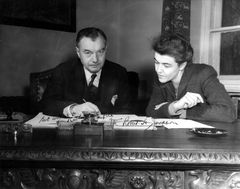
April 12: President Roosevelt dies and Vice President Harry Truman is sworn in as President of the United States. In his first days in office, Truman asks Supreme Court Justice Robert Jackson to serve as chief U. S. prosecutor in the Nuremberg war crimes trial.
April 25: The San Francisco conference begins work on the formation of the United Nations organization as agreed in the protocol of proceedings at the Yalta conference.
April 29: United States troops liberate survivors at Dachau concentration camp.
April 30: Adolf Hitler commits suicide.
May 2: President Truman names Robert Jackson as U. S. Chief of Counsel for the prosecution of Nazi war criminals.
May 5: United States troops liberate Mauthausen concentration camp.
May 6: Field Marshal Hermann Wilhelm Goering surrenders to the Allies.
May 8: President Truman declares Allied victory in Europe on his sixty-first birthday. Germany surrenders unconditionally and the war in Europe comes to an end.
June 26: Jackson departs Washington to meet with his Allied counterparts in London to discuss legal proceedings against Nazi officials.
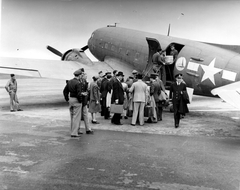
July 7: Jackson visits Nuremberg and recommends it as the site for the upcoming trials.
August 2: In Section VII of the Potsdam Protocol, the British, American, and Soviet Governments affirm their intention to bring war criminals whose offenses did not occur in a particular geographic location to swift and sure justice. They announce that the first list of defendants will be published by September 1.
August 6: United States drops the atomic bomb on Hiroshima.
August 8: The Allies sign the London Agreement. This legal agreement mandates the prosecution of war criminals by the International Military Tribunal. The agreement is signed by representatives of the United States, Great Britain, France, and the Soviet Union. The constitution, jurisdiction and functions of the International Military Tribunal are set in the charter of the London Agreement. Nothing in this agreement prejudiced the provisions established by the Moscow Declaration concerning the return of war criminals to the countries where they committed their crimes.
September 5: President Truman meets with Jackson to discuss the appointment of former Attorney General Francis Biddle as American judge at Nuremberg.
October 6: The prosecutors appointed by the four powers publish their joint statement of indictment.
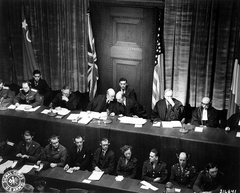
October 14: Sir Geoffrey Lawrence of the United Kingdom is elected President of the International Military Tribunal.
October 18-19: Indictments are issued by the International Military Tribunal against twenty-four men and seven organizations. The men and organizations are charged with the systematic murder of millions of people.
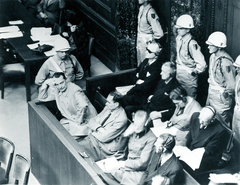
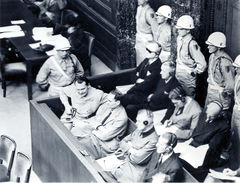
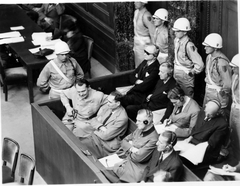
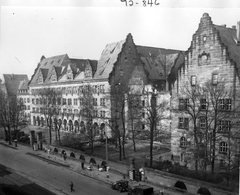
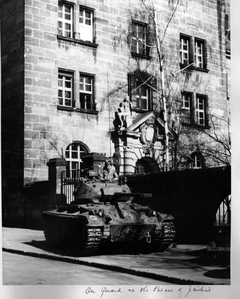
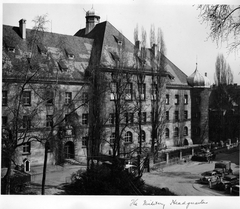
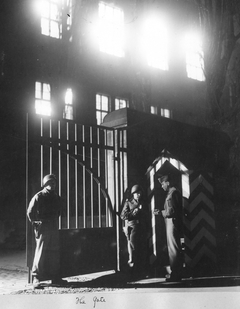
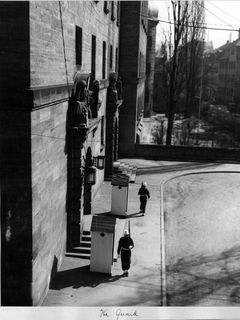
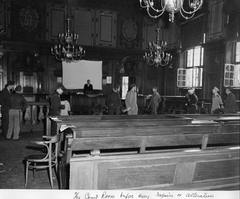
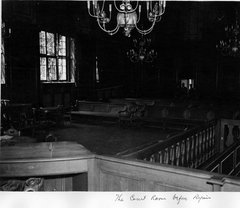
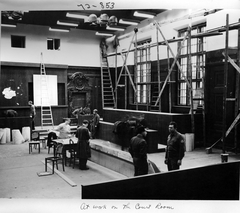
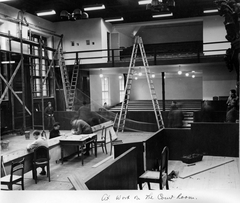
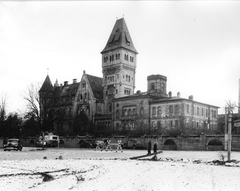
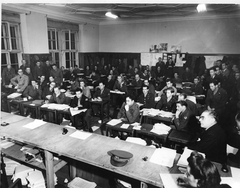
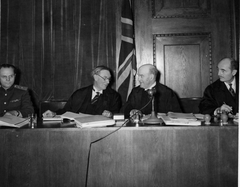
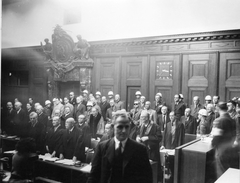
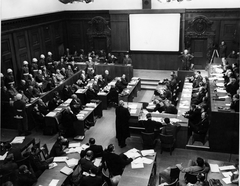
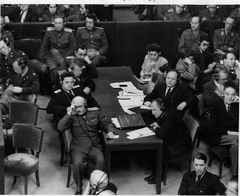
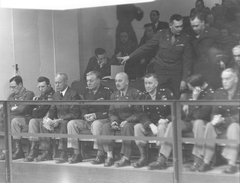
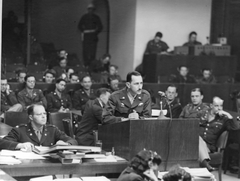
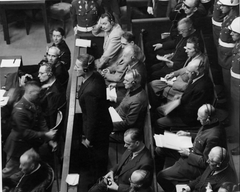
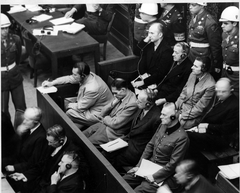
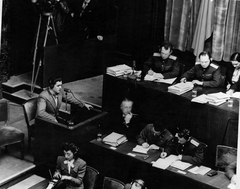
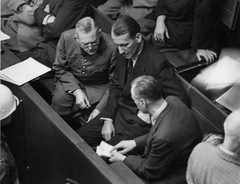
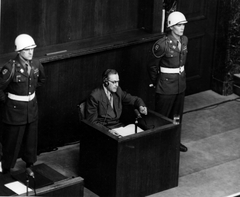
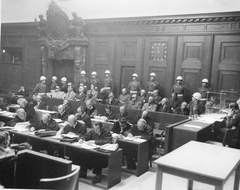
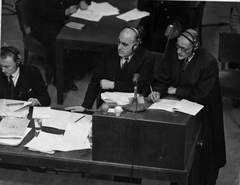
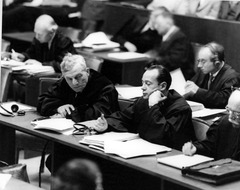
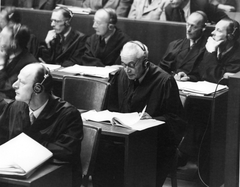
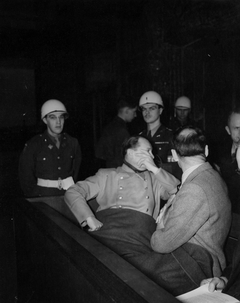
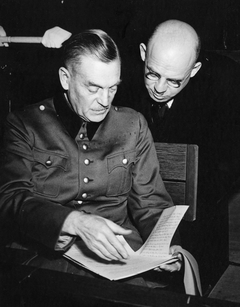
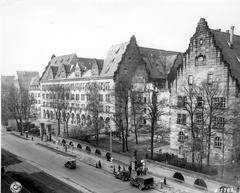
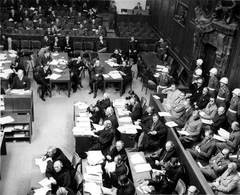
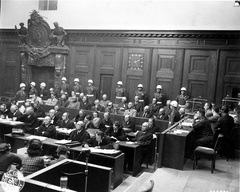
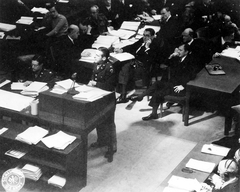
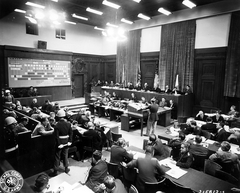
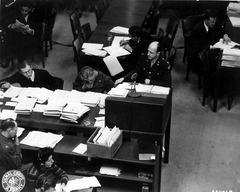
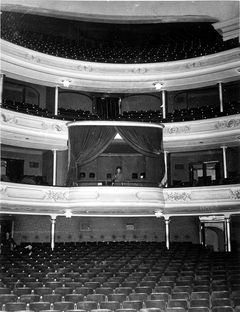
November 20: The trial of the major war criminals by the International Military Tribunal begins at the Palace of Justice in Nuremberg, Germany.
November 21: Jackson delivers his opening statement for the prosecution. All defendants plead "not guilty."
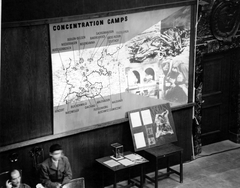
November 29: The prosecution introduces film footage shot by Allied photographers to demonstrate crimes against humanity that had been committed in newly liberated areas.
December 13: The prosecution introduces evidence of crimes against humanity from Buchenwald concentration camp.
December 18: The prosecution introduces evidence against seven German organizations connected with the Nazi party leadership and the German High Command.
December 20: The Control Council for Germany enacts Control Council Law Number 10, concerning trials and war criminals. It gives effect to the terms of the Moscow Declaration and the London Agreement, and establishes a uniform legal basis in Germany for the prosecution of "lesser" war criminals and other offenders dealt with by the International Military Tribunal.
1946
January 4: Colonel Telford Taylor presents the prosecution case against the German High Command. Taylor's eloquence in these proceedings is a factor that leads to his appointment as lead prosecutor in later Nuremberg trials.
January 8: The prosecution begins its case against individual defendants.
January 28: During the French phase of the prosecution, evidence of atrocities committed at Auschwitz concentration camp is presented.
February: The Soviet Union's prosecutor provides evidence of German atrocities in Eastern Europe.
March 6: The Soviets finish their presentation and the prosecution rests.
March 8: The defense begins its case. Field Marshal Hermann Goering begins his testimony.
March 18-22: Hermann Goering is cross-examined.
March 29: Telford Taylor is appointed to succeed Jackson as chief prosecutor at Nuremberg.
April 1: Auschwitz concentration camp commandant Rudolf Hoess begins his testimony about the mass executions at his camp.
April 1-2: Joachim von Ribbentrop, foreign minister, testifies.
April 11: Dr. Ernst Kaltenbrunner, head of the Reich Main Security Office of the SS, testifies.
April 18: Hans Frank, Hitler's legal adviser and Bavarian Minister of Justice, testifies. Frank was known as the "butcher of Poland."
April 26: Julius Streicher, founder of the German Socialist Party, testifies.
April 30: Hjalmar H.G. Schacht, President of the German Reichsbank, testifies.
May 3: Walther Funk, Minister of Economic Affairs and Chief Press Officer for the Third Reich, testifies.
May 8: Grand Admiral Karl Doenitz testifies.
May 20: Grand Admiral Erich Raeder testifies.
May 23: Baldur von Schirach, head of Hitler Youth, testifies.
May 28: Fritz Sauckel, plenipotentiary for the mobilization of labor, testifies.
June 3: General Alfred Jodl, chief of the operations staff of the German high command, testifies.
June 10: Arthur Seyss-Inquart, Reich Commissioner of German-occupied Netherlands, testifies.
June 14: Franz von Papen, former Chancellor of Germany, testifies.
June 21: Albert Speer, Minister for Armaments and Munitions, testifies.
July 4: Defense summations begin in the Major War Criminals Trial.
July 26: The prosecution begins its summation in the Major War Criminals Trial.
July 30: The defense of the seven indicted Nazi organizations begins.
August 20: Hermann Goering returns to the witness stand.
August 30: Testimony is completed in the Major War Criminals Trial.
August 31: Defendants make their final statements.
September 2: The justices meet to discuss verdicts in the Major War Criminals Trial.
October 1: The verdicts against the major war criminals are handed down by the International Military Tribunal. Eleven of the defendants are sentenced to death. Three are acquitted. Three receive life sentences. The remainder receive sentences that range from ten to twenty years in prison. In addition, the missing Martin Bormann is sentenced to death in absentia. (Another defendant, Robert Ley, had committed suicide before the trial began.)
October 13: The Allied Control Council - with the power to reduce or commute sentences - rejects all appeals in the Major War Criminals Trial.
October 15: The defendant Hermann Goering commits suicide.
October 16: Ten war criminals are hanged in Nuremberg.
October 18: Ordinance No. 7 is issued. While the Charter of the International Military Tribunal contained provisions on the powers of the court and the procedure, such provisions are missing in Control Council Law No. 10. No. 7 supplies the jurisdictional and procedural provisions according to which the subsequent trials will be conducted.
October 25: Twelve trials of 199 officials of the Nazi regime are held in Nuremberg before American military tribunals. The military tribunals are different from the first group of Nuremberg hearings because only the United States officiates. Prosecutors from Great Britain, France, and the Soviet Union are not included.
October 25: The United States Military Government for Germany begins Case No. 1 by filing indictments against twenty-three Nazi physicians in the first of twelve trials in Nuremberg. The doctors' tribunal crimes include: murders, brutalities, cruelties, tortures, atrocities, and other inhumane acts. Those indicted include: Karl Brandt, personal physician to AdoIf Hitler; Siegfried Handloser, Chief of the Medical Services of the Armed Forces; and Paul Rostock, Chief of the Office for Medical Science and Research. The closing statements are completed on July 14. Judgments are rendered on August 19 and 20, and confirmed on November 22, 1947.
November 13: Case No. 2 begins with the filing of an indictment against Erhard Milch, a Field Marshal in the German Air Force who was responsible for the production of aircraft during the war and was also a member of Albert Speer's Central Planning Board. This is the only case conducted in Nuremberg with a single defendant. The indictment has three counts: 1. (War crimes): Mistreatment of civilians of occupied territories and prisoners of war as slave laborers; 2. (War crimes): Medical experiments (high altitude and freezing) on concentration camp inmates; 3. (Crimes against humanity): Slave labor and medical experiments on German nationals and citizens of other countries. Milch is accused of direct participation in the conscription and mistreatment of slave laborers, and of administrative responsibility for the medical experiments conducted for the Air Force. He is found guilty only of one count on April 17, 1947. The sentence is confirmed on November 22, 1947.
December 11: The General Assembly of the United Nations affirms the principles of international law recognized by the Charter of the Nuremberg Tribunal and the judgment of the Tribunal.
1947
January 4: Indictments are issued in Case No. 3, also known as the "Justice Case." The case was also formerly known as the United States against Josef Altstoetter, et al. Those persons charged in the justice case are persons holding high positions under the Nazi regime, involved in the administration of the courts. Judgment is entered on December 3 and 4, 1947, and confirmed on January 18, 1949.
January 13: Case No. 4 begins with the submission of the indictment on January 13, 1947. It is also known as the Pohl case. It is one of three cases known as SS cases. Oswald Pohl was the chief of the economic and administrative department of the SS. The other defendants were officials of the same division. They were responsible for the operations of concentration camps, mines, and many factories. The case closes September 17, and judgments are rendered on November 3, 1947. According to the prosecution, approximately 10,000,000 persons were imprisoned in these camps. Specific charges include: imprisonment of civilians, nationals of foreign countries, and prisoners of war; exploitation of inmates as laborers; medical experiments conducted on prisoners; extermination of the Jews; sterilization; mistreatment of prisoners of war; euthanasia; deportation of foreign nationals, and plundering of their property. Though judgments and sentences are handed down on November 3, 1947, the case is not bought to an end until U.S. High Commissioner John J. McCloy hands down revised sentences on January 31, 1951.
February 8: Case No. 5, the trial of Friedrich Flick and five other officials, is the first of the industrialist cases. The specific counts charge slave labor, the spoliation of property in occupied France and the Soviet Union, the "Aryanization" of Jewish industrial and mining properties, support of the SS and the "Circle of Friends of Himmler." In its judgment the Tribunal finds the defendant Flick guilty under the charges of slave labor, support of criminal activities of the SS and financial contributions to the "Circle of Friends of Himmler." The judgment is confirmed June 30, 1948.
February 17: Ordinance No. 11 is issued to amend Ordinance No. 7. The ordinance provides more procedural provisions to be used to conduct the subsequent trials.
May 3: Indictments are filed in Case No.6, commonly called the "Farben Case." The trial of 23 officials of the I.G. Farben company is the second of the industrialist cases. It is filed before the Krupp case and after the Flick case. The closing case for the prosecution which took only one day is made June 10, 1948. Judgments are made July 29 and 30, 1948 and confirmed March 4, 1949.
May 10: Indictments are filed in Case No. 7, also known as the "Hostages Case" on May 10, 1947. The persons indicted are leaders in the army who are charged with various war crimes. Some of the crimes were carried out in the invasion and occupation of Greece and Yugoslavia . The closing arguments for the Prosecution are made on February 3, 1948, and sentences are confirmed by the Military Government on January 18, 1949.
July 1: Indictments are filed on July 1, 1947 in Case No. 8, commonly known as the "RuSHA" Case or the United States vs. Ulrich Greifelt, et al. This case is known as one of the SS cases, and it deals mainly with the Main Race and Resettlement Office and the Main Office for Repatriation of Racial Germans. The defendants are charged with criminal conduct and with a systematic program of genocide. These offices were the backbone of the Nazi racial program.
July 30: Case No. 9, the "Einsatzgruppen Case" is officially named the United States of America vs. Otto Ohlendorf, et al. Special Task Units, or Einsatzgruppen, were formed just before Germany attacked Russia. Their principal purpose was to follow the German Army and exterminate Jews, gypsies, Soviet officials and other elements regarded as inferior. This program incurred about one million victims. Fourteen members of German mobile killing units are sentenced to death. Indictment is filed July 30, 1947 and the case opens on October 20. The sentences are confirmed without reduction on March 7, 1949.
August 17: The last industrial case, Case No. 10, was the Krupp Case. All defendants are charged with crimes against peace and with participation in a common plan or conspiracy to commit crimes against peace. The indictment was filed August 17, 1947.
November 1: The indictment in Case No. 11, known also as the "Ministries Case" is filed November 1, 1947. The case opens for trial on January 6, 1948. Defendants include members of the foreign office, financial ministers, bankers, and politicians. What the defendants have in common is the fact that they were all influential persons in the conduct of the war. Judgment is not given until April 14, 1949.
November 28: Indictments in case No. 12, the "High Command Case" are filed on November 28, 1947. The trial opens on February 5, 1948. Many of the defendants had attended Hitler's conferences in which he discussed plans of invasion and some had helped to prepare invasions. The closing statement of the Prosecution is made August 10 and the judgment rendered October 27, 1948.
1948
May 14: The State of Israel is established.
December 19: The United Nations issues the Universal Declaration of Human Rights.