
Chronology Harry S. Truman's Life and Presidency
Presidential -- Second Term, 1949-53
1949
5 January: Delivered State of the Union message asking for strengthened liberal program characterized as the "Fair Deal."
20 January: Marshall resigned as secretary of state. Dean Acheson succeeded him on 21 January.
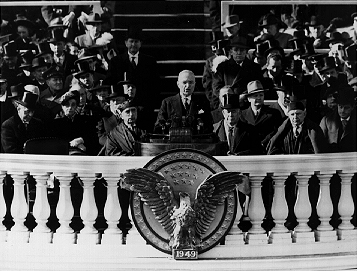
20 January: Inaugurated for second term. In inaugural address, called for "bold new program" to help underprivileged peoples of the earth (Point IV Program).
6 June: Signed executive order establishing office of U.S. High Commissioner in Germany as step in replacing army supervision with civilian control in that country.
15 July: Signed Housing Act established a national housing policy and providing for federal aid to slum clearance programs and low-cost housing projects.
10 August: Signed National Security Act Amendment, establishing a unified Department of Defense.
24 August: Proclaimed the North Atlantic Pact, which had been signed by twelve nations in Washington on 4 April, to be in effect. Implementation of pact entrusted to North Atlantic Treaty Organization (NATO). On 19 December 1950 Dwight D. Eisenhower was appointed commander of the combined forces, being designated Supreme Allied Commander, Europe.
23 September: Announced that there was evidence of a Russian atomic explosion.
6 October: Signed Mutual Defense Assistance Act authorizing appropriation of funds for military assistance to nations signing the North Atlantic Pact.
1950
31 January: Revealed that he had ordered the Atomic Energy Commission to develop the hydrogen bomb.
26 June: Ordered U.S. air and sea forces to aid South Korean Troops in resisting the Communist forces of North Korea which had invaded South Korea the day before.
30 June: Announced that he had ordered American ground forces in Japan to Korea and the navy to blockade the Korean coast. The president's Korean policy was backed by the U.N. Security Council. General Douglas MacArthur, the American commander in Japan, was put in charge of all U.N. troops in the area, which included forces from other nations.
19 July: Sent message to Congress asking for supplemental appropriation to support the Korean police action and for measures to control the country's economy.
25 August: Ordered seizure of the railroads by the government on 27 August to forestall nationwide strike.
8 September: Signed Defense Production Act establishing priorities, price and wage stabilization program, and limiting installment buying.
12 September: Accepted resignation of Louis A. Johnson as secretary of defense. Johnson succeeded by General George C. Marshall on 21 September.
23 September: Signed the Revenue Act of 1950 increasing corporation and income taxes.
15 October: Conferred with MacArthur on Wake Island concerning Far Eastern policy.
1 November: Escaped attempted assassination by two Puerto Rican nationalists.
6 December: Wrote a personal letter to music critic Paul Hume, assailing him for his "lousy review" of a recital given by daughter Margaret. The president's strong language aroused public controversy, but the majority of mail was in his favor.
16 December: Proclaimed state of national emergency following entry of Communist China into the Korean conflict on 6 November, after U.N. forces had taken over most of North Korea.
1951
11 January: Appointed mission headed by John Foster Dulles to go to Japan to confer with MacArthur and Japanese leaders in regard to a Japanese peace treaty. Treaty signed in San Francisco on 8 September by delegates from forty-eight countries, Russia and her satellites refusing to participate.
26 March: Opened fourth meeting of the foreign ministers of the twenty-one American republics in Constitution Hall, Washington, DC.
11 April: Relieved MacArthur of all posts as commander of American and U.N. forces in the Far East for making statements critical of the government's military and foreign policies in that area. MacArthur replaced by Lt. Gen. Matthew B. Ridgway.
15 June: Signed India Emergency Food Aid Act, lending $190 million to India to buy up to two million tons of grain.
1 August: Proclaimed suspension of tariff reductions for Soviet Russia, People's Republic of China, and other Communist countries.
10 October: Signed Mutual Security Act authorizing $7,483,100,000 for foreign economic, military, and technical aid and establishing the Mutual Security Agency.
20 October: Nominated General Mark W. Clark to be ambassador to the Vatican. Move was both praised and condemned and Congress failed to act on the appointment. On 13 January 1952 White House announced that at Clark's request his nomination would not be resubmitted.
24 October: Proclaimed state of war with Germany to be officially at an end as of 19 October.
1952
2 January: Submitted to Congress plan to reorganize Bureau of Internal Revenue in response to charges of inefficiency and corruption in that agency. Plan, which called for replacing sixty- four politically appointed collectors with twenty-five district commissioners under Civil Service, became effective 15 March after receiving Senate approval.
5-9 January: Conferred at Washington with Winston Churchill, recently reelected prime minister of Great Britain, and other British and American officials, concerning common problems in Europe and the Middle and Far East.
27 March: Reestablished residence in the White House after living in Blair House, the official government guest house, since November 1948, while the White House was being rebuilt and renovated.
29 March: Announced at Jefferson-Jackson Day dinner decision not to run for reelection.
8 April: Signed executive order direction Secretary of Commerce Charles Sawyer to seize steel mills to prevent strike of steel workers. On 2 June seizure was declared unconstitutional by the Supreme Court in a six to three decision.
15 April: Signed ratification of peace treaty with Japan and defense treaties with Japan, Australia, New Zealand, and the Philippines.
29 May: Vetoed joint resolution of Congress confirming state claims to submerged lands below the low water mark (so-called "tidelands" dispute).
14 June: Laid keel of the USS Nautilus, world's first atomic powered submarine, at Groton, Connecticut.
2 September-1 November: Made five campaign speaking tours in behalf of Adlai Stevenson, the Democratic party's candidate for president.
5 November: Invited president-elect General Dwight D. Eisenhower to White House to discuss problems of transition from one administration to the next after Republican victory on 4 November. Meeting between Truman and Eisenhower took place on 19 November.
1953
20 January: Attended inauguration of President Eisenhower and then left by train for Independence, Missouri.
Chronology Table of Contents
- Pre-Presidential Years 1840-1945.
- First Term as President 1945-1948.
- Second Term as President 1949-1952.
- Post-Presidential Years 1953-1972.